

BLOG

HOW YOU MOVE IN THE GYM = HOW YOU MOVE IN LIFE
Online Fitness Training & Movement Rehab by a Qualified Physiotherapist & Personal Trainer.

So you've started up a new gym routine, you've got the gear, you've got the motivation and you've got the gym membership. Just don't leave the knowledge required to train you safely and effectively at the door!
You may have a Personal Trainer, but not all Personal Trainer's are created equal. Some can push you to the point of injury and beyond. If your Personal Trainer is letting you repeat a poor movement habit without correcting you over a period of time, this can create dysfunction in your body and those movement habits stay with you for life if not changed. Inevitably, leading to injury further down the track. If you have a Personal Trainer, make sure they have a lot of knowledge on the human body and movement and not just a PT certification as this is not enough to train people safely.
It's not all about Personal Trainers though, you may be training yourself and that's great! Just make sure you aren't performing poor movement habits. It is worth educating yourself on proper movement technique for all basic movements such as squats; lunges; pull-ups; pushups etc before going crazy at the gym.
I've spent a lot of time in different commercial gyms and have seen a whole lot of poor movement. You know that person is inflicting harm on themselves and they probably don't even know it YET.
When it comes to FOOTWEAR, less is more! When it comes to EXERCISE CHOICE, there are too many variables influencing this, but you always want to include functional, full body movements in your workout. And when it comes to WHY, well this is where it gets fun, as really it comes down to what your flexibility is like; where your strength is at; what your goals are; how you feel on the day - so many variables that affect WHY you choose certain movements over others.
If you find yourself stuck in a rut with working out or are unsure how to put workouts together for yourself then consider joining our Your Moov strength program. Where we program all your workouts for you so you can spend more time training & less time thinking.
You won't regret it!

THE TRUTH ABOUT OSTEOPOROSIS
The truth about Osteoporosis and how you can help yourself.

I have summarised some very relevant points gathered from two articles by Functional Diagnostic Nutrition (www.functionaldiagnosticnutrition.com) on the topic of Osteoporosis.
Research has found that bone density remained relatively constant over the course of human evolution, but sharply declined in the modern era. The drop in bone density correlates with shift from hunting and foraging to agriculture and industrialisation.
It would appear that our modern lifestyles, food, and environment has taken a toll on our bones. Osteoporosis is a serious concern for our ageing population. The good news is that problems with bone health can be prevented and even reversed through simple tools.
Our bones are like storage banks for minerals such as calcium, magnesium and phosphorus. Blood levels of calcium are tightly regulated, and kept within a very narrow range. This is one of the most strictly controlled processes in the body. When calcium blood levels start to fall below this range, stored calcium can be “withdrawn” from the bones in a process called resorption. On the other hand, as calcium blood concentrations start to approach the upper limit, calcium is often “deposited” back into the bones matrix in a process called absorption. These two processes, resorption and absorption are constantly “remodeling” or changing the shape and structure of the bone.
Blood calcium levels are regulated by a hormone which is produced by the parathyroid glands. These small glands are located in the neck and sit behind the thyroid gland. This hormone is released in response to low blood calcium, stimulating osteoclasts, cells which cause bone to release calcium into the blood. This hormone can also inhibit osteoblasts, cells which deposit bone, reducing the amount of calcium absorption in bone.
In some people, withdrawal of calcium from the bones can be abnormally high and deposition of calcium in the bones abnormally low. When calcium withdrawals in the bone continually exceed deposits, it leads to a deficit. A calcium deficit results in osteoporosis.
Generally speaking, the allopathic medicine approach to treating osteoporosis includes increasing some combination of calcium intake, medications, vitamin D supplementation, and sometimes exercise. The problem is, after a year or two of treatment, bone mineral density often shows minimal improvement, if any, and in some cases, gets worse. This type of approach to the bone-mineral density issue is akin to putting out a forest fire with an eyedropper.
Osteoporosis is not the problem, it is a symptom of the problem.
There are many potential factors that can contribute to the presentation of a bone density problem, and they can differ from one individual to the next. Frequently, there will be not one, but several dysfunctions in the body that lead to the condition of osteoporosis. Having said that, if we seek to prevent and correct osteoporosis, we must first seek to identify and correct the underlying dysfunction.
Here are two of the most common reasons for the prevalence of osteoporosis in our modern society:
STRESS (Internal & external), it’s everywhere! Chronic stress is a silent killer, and is at the root of many debilitating illnesses. Stress response in the body can be initiated by either mental/emotional, physical, or biochemical threats. Some are external, meaning they happen outside our bodies, while other stressors are internal, or hidden inside our bodies. Either way, chronic stress can contribute to the type of dysfunction that can lead to osteoporosis.
Some examples of external stressors include:
Prolonged high intensity exercise without proper recovery
Structural Issues such as spinal or jaw misalignments
Inadequate quality and quantity of sleep
Restrictive very low calorie or low fat or low carbohydrate diets
Ingestion of toxins from food, alcohol or tobacco
Contact with toxic chemicals and material at home and work
Examples of Internal Stressors include:
Blood sugar issues
Physical pain or trauma
Disease or illness
Fungal, bacterial, or parasitic infections
Hormonal imbalances
Progesterone
One of the most common stress related dysfunctions that lead to osteoporosis is a chronic reduction in progesterone levels. One of the main roles of this hormone is to oppose estrogen and signal osteoblasts to build bone. So, low levels of progesterone means less bone-building.
Stress creates an environment where the raw materials used to make progesterone are diverted to making cortisol, instead. Cortisol is the body’s key stress hormone; its production can take priority above progesterone in times of increased stress. In addition to reducing progesterone levels and increasing the risk of osteoporosis, increased cortisol can lead to a variety of other dysfunctions throughout the body such as leaky gut, decreased neural function, hormonal, immune, and metabolic dysfunction.
Magnesium
Chronic stress, regardless of the source, will “bleed” magnesium from the body and create retention of calcium in body tissues. This creates an issue in those who take calcium supplements yet are deficient in magnesium and have insufficient fat intake. Calcium can accumulate in the soft tissues causing muscular pain and cramping.
It is worth noting that some research has suggested that high supplemental calcium intake in some people increases the onset of stress reactions within the body, leading to the production of stress hormones such as adrenaline and cortisol. If this is the case, high dose calcium supplements may be doing you more harm than good.
Gut Dysfunction
In the simplest terms, if you have a defective digestive system, you can consume tons of calcium, and it will never make it to your bones. When the gut is dysfunctional, your Autonomic Nervous System, which controls all of the functions of your body that happen automatically without you having to think about them, including bone remodeling, becomes dysfunctional, as well. An impaired gut will bring about issues with nutrient absorption, assimilation, and metabolism.
In addition, gut dysfunction causes a chronic stress response, overloading the immune system and eventually manifesting in the stress-related issues mentioned above. Food intolerances and sensitivities, if undiscovered, could make it very difficult for a person to heal.
What You Can Do to Recover from Osteoporosis
The good news is that there is a lot that you can do to prevent and recover from this otherwise debilitating condition. It is important to understand that simply popping a pill will not solve this (or any) dysfunction in the body. Instead, you can aim to optimize your physiology by incorporating lifestyle changes such as diet, rest, exercise, stress reduction, and supplementation to support and nurture your body’s own innate healing ability.
In order to truly defeat Osteoporosis, it is important to identify why there is an issue with your bone density in the first place. This can involve diet and lifestyle assessment as well as screenings for hidden stressors that may be taxing the body and creating a chronic stress response, such as poor thyroid function, blood sugar dysregulation, food/chemical intolerances, gut dysfunction, hormonal balance, inflammatory status, etc. Failing to identify hidden stressors (structural stress, thyroid and/or adrenal issues, gut dysfunction, hormonal balance, etc.) prevents one from implementing a true healing program that will produce long-term results.
The key cause of osteoporosis can be either mental, emotional, biochemical (nutritional), and structural (physical) stress because all of these types of stress ultimately lead to reduced bone density. The best way to prevent and recover from osteoporosis is to learn to identify and manage life stressors, regardless of the source, and give YOUR body the support it needs to foster optimal health and vitality.
Another key to preventing Osteoporosis, particularly through Menopause, is with strength training. Loading our muscles with weight training will stimulate bone growth. If you need a program to help you build more muscle & improve your overall health & longevity, have a look at our Your Moov program. We plan all your workouts for you so you don’t have to feel lost in the gym.
Source: Article Part One; Article Part Two

PREVIOUS INJURY IS A BIG PLAYER IN THE MOVEMENT GAME!
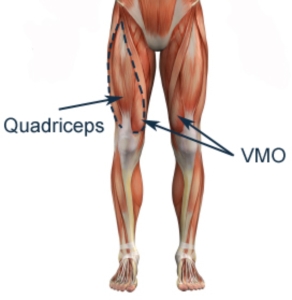
One of my clients, who is a keen diver, tells me whenever he swims or dives he usually always gets pretty bad cramping in his right hamstring towards the end of the swim/dive and wandered if there was anything he could do for it.
After a couple of minutes of assessment I had discovered he had a hamstring to quad dysfunction & his hamstrings were compensating for his medial quadricep (Vastus Medialis) predominantly. His VMO muscle (Oblique fibres of the Vastus Medialis that form the teardrop muscle at the knee) was particularly weak and had some noticeable wasting. His quadriceps in general on the Right side were slightly wasted in comparison to the Left.
He then precedes to tell me when he was 15 years old (+-50 years ago) he tore his medial quad & never got treatment on it, there was a noticeable dip in the muscle bulk as well which had been there ever since (a give away for a full tear or a possible partial tear). EUREKA!
So our findings related back to an ancient injury from decades ago that has manifested as dysfunction in his right side and causing him problems at this time. He admitted never having issues after the injury healed and kept playing footy for years.
Moral of the story, even though his injury was decades old and he'd adapted to it in a way that enabled him to get away without too much trouble for many years, it eventually comes back to bite you in the ass! Some cases being worse than others but don't ride on dysfunction for too long as it will always win! Post injury compensations stay with you for life, unless of course, you seek help to change them!
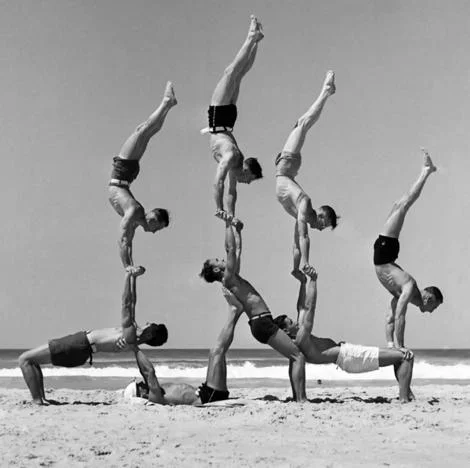
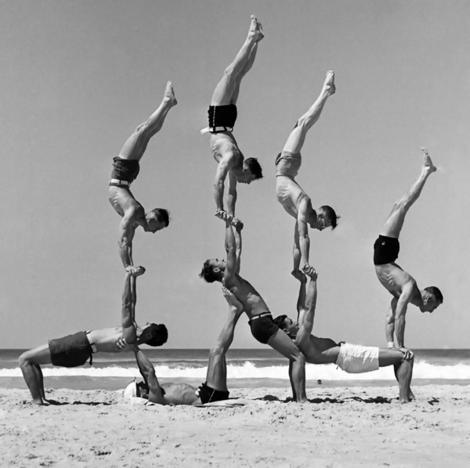
MOVEMENT...WHAT IT REALLY MEANS!

American Turner Gymnasium 1860
An online lecture I saw recently given by Dr Ed Thomas, an expert in the foundation of Physical Education, drove me to analyse what fitness is today in comparison to what it was historically. Historically, there are three fundamentals of movement and fitness, these are Progression, Variety & Precision.
Now from what I can tell and have observed over the years is that the majority of fitness enthusiasts seem to do well to take care of the Variety aspect of fitness, it's not hard to keep workouts varied. Progression seems to be mostly adhered to, it's quite simple, you learn a movement to a satisfactory level until it becomes quite comfortable and then you progress that movement, either by adding weight, increasing reps or challenging the movement to a higher level of difficulty (i.e. advancing from a squat to a single leg squat progression). Now, I have to take a pause here, although progression seems to be quite evident in most fitness programmes, there is a little issue that is quite niggling…this would be the over-eagerness to progress. This is a huge issue that is present within our field, you may have someone who is recently able to squat their own bodyweight comfortably but then wants to throw 40kgs onto their back and continue to squat, or a personal trainer who wants to make a client sweat more by handing them heavier weights resulting in a less precise movement pattern. You can't expect the body to move as efficiently with extra load in a movement pattern that is newly learned with only bodyweight or that is challenging enough with the current weight used. This brings me to the third and final (and I personally believe the most important) fundamental...Precision.
We need to find a way back to basics and get the population moving well and precisely again, we are so far away from our own mind-body connection that most people just go through the motions of exercise without ever making a conscious connection to how they are moving, why they are moving or how they are breathing. There was no sloppiness in movement back in the 1800's & most of the 1900's, precision was the key focus and the fitness just followed.
In Gray Cook's book, "Movement", he talks about the origins of Martial Arts and sums up what fitness should and used to be. Somehow recent generations have managed to distort this approach and turn it on it's back. Current jobs and lifestyles have a huge role to play and make it hard for the body to hold onto fundamental physical fitness, but not impossible by far! "Purposeful movement perfection was the focus, and physical conditioning happened as a natural side effect".

Modern day gyms are stacked full of equipment promoting dysfunctional movement. The use of fixed machines encourage your body not to utilise it's core stabilising musculature and instead, rely on your large, global muscles for movement. In our daily lives we need to be able to squat, lunge, push, pull, reach, run, bend and rotate, all done whilst fighting gravity (not sitting locked into a machine). This is when our bodies are moving as intended. These are the movements we need to perfect and do with precision in order to be healthy, fit individuals avoiding injury.
Look at gyms from ancient times and see if you can spot a hamstring curl, a pec deck or a leg extension machine anywhere? They only use anti-gravity equipment in the form of ropes, rings, parallel bars, ladders etc and hand weights in the shape of dumbbells, kettle bells, medicine balls and clubs.
Train functional movement patterns and make sure you do it with Precision, Variety & Progression in order to achieve true fitness. Don't rush into a new movement before you have perfected its predecessor and don't load up a movement pattern before being comfortable and strong enough in doing it body weighted first.
NO. 4 AND FINAL OF OUR TOP 4 AB EXERCISES: FITBALL OR TRX JACKNIFE AND/OR PIKE
Jackknife and Pike on a fitball or TRX. A great ab and core exercise for hitting the abs hard!
Want to train your ABS in an efficient, functional way?
As mentioned in the previous Sit-up posts, you all know (unlike most personal trainers), I am no fan of traditional sit-ups. So here is the fourth and final of 4 alternatives that will hit your abs hard and give you that burn that you probably desire. As well as increase the function of your core area if done correctly.
No. 4 in our Top 4 ab exercises
4. TRX or Fitball Jackknife/Pike:
This is really two in one as the pike is a good progression from the Jackknife!
Using either a fitball or a TRX for the Jackknife.
Hands on floor in a pushup position with shins and ankles on fitball (or feet into TRX straps). Push your hands away from the floor to activate your shoulders, gently push your ankles into the ball and drive your knees towards your elbows. Make sure you brace your core and don't let your pelvis sag down or raise up too much. Keep your shoulders stable so there is no movement through them.
The pike is very similar but instead of bending the knees, keep them straight, push your feet into the fitball or straps and reach your butt towards the ceiling, whilst still pushing your hands away from the ground. Keep your neck neutral, I could probably have tucked my chin in a little bit more in this video.
Only lift your hips as high as is comfortable. Mine go pretty high but start by getting used to the movement first and making sure you’re moving through your hips and not your lower back.
These are both quite advanced moves so please only attempt if you have relatively good stability and strength.
Otherwise, give it a go! :-)
LEARN HOW TO TRAIN SMART!
JOIN US AND TRAIN ONLINE USING OUR VERSATILE APP!
YOU WILL LEARN THE FUNDAMENTALS OF MOVEMENT AND HOW TO EXERCISE SMART.
PROGRAMS THOUGHTFULLY PUT TOGETHER BY A PHYSIOTHERAPIST QUALIFIED PERSONAL TRAINER.
GETTING YOU ON THE ROAD TO FITNESS SAFELY AND EFFECTIVELY!
NO. 3 OF OUR TOP 4 AB EXERCISES: STIR THE POT OR A FITBALL PLANK REGRESSION
Want to train your ABS in an efficient, functional way?
As mentioned in the previous Sit-up posts, you all know (unlike most personal trainers), I am no fan of traditional sit-ups. So here is the third of 4 alternatives that will hit your abs hard and give you that burn that you probably desire. As well as increase the function of your core area if done correctly.
No. 3 in our top 4 ab exercises
3. STIR THE POT:
This is a killer exercise for your abs and core!
Find a fitball, assume the plank position with a wide stance at the feet to begin with as this will be more manageable at first. Elbows on the ball but aim them to be just underneath the shoulders and about shoulder width apart.
SQUEEZE your gluts, PUSH your elbows into the ball to lift your body away from it. Make sure your butt isn't sticking in the air or lagging towards the ground (think good plank position).
If this is challenging enough then just start with a plank hold and work your way up to achieving 60seconds. Once this is manageable only then attempt the STIR THE POT.
Now you are ready to begin...whilst maintaining as close to zero movement through your torso as possible, gently make small circles with your elbows. Aim for around 6-8reps one way and then repeat the other way. You can then build on the reps as you get stronger or go for time instead.
This is a great exercise for training your abdominal region to stabilise your pelvis and lower back. If you find your pelvis is rotating with this exercise and you are struggling to control it then maybe go back to the pallof press for a while as it may be a sign that your obliques are not in good working order.
Give it a go and let me know what you think.
LEARN HOW TO TRAIN SMART!
JOIN US AND TRAIN ONLINE USING OUR VERSATILE APP!
YOU WILL LEARN THE FUNDAMENTALS OF MOVEMENT AND HOW TO EXERCISE SMART.
PROGRAMS THOUGHTFULLY PUT TOGETHER BY A PHYSIOTHERAPIST QUALIFIED PERSONAL TRAINER.
GETTING YOU ON THE ROAD TO FITNESS SAFELY AND EFFECTIVELY!
1 OF OUR TOP 4 AB EXERCISES: PALLOF PRESS
As promised from our previous post, here is the first of four of our top abdominal exercises that won't harm your lower back.
Want to train your ABS in an efficient, functional way?
As mentioned in the previous Sit-up post, you all know (unlike most personal trainers), I am no fan of traditional sit-ups. So here is the first of 4 alternatives that will hit your abs hard and give you that burn that you probably desire. As well as increase the function of your core area if done correctly.
1. PALLOF PRESS:
This is a killer exercise for the OBLIQUES!
Kneel down side on to either a light powerband or a cable (I would start with 10kg and go from there, this is harder than it looks!). You only need a small amount of tension if using the Powerband. Keep your hips locked out and hold the cable/powerband level with the bottom of your sternum. As you breathe out, extend the arms and lockout the elbows. The band/cable will want to pull you across to the attachment, the aim is to not let it, make sure you don't hold your breath or flex the hips, if you do then back off the band a bit or lower the weight.
Once this is manageable then try hold the arms out for a count of 5 seconds whilst still breathing.
LEARN HOW TO TRAIN SMART!
JOIN US AND TRAIN ONLINE USING OUR VERSATILE APP!
YOU WILL LEARN THE FUNDAMENTALS OF MOVEMENT AND HOW TO EXERCISE SMART.
PROGRAMS THOUGHTFULLY PUT TOGETHER BY A PHYSIOTHERAPIST QUALIFIED PERSONAL TRAINER.
GETTING YOU ON THE ROAD TO FITNESS SAFELY AND EFFECTIVELY!

Sweet Little Things - Healthy Treat Recipes
This great little information packed ebook not only contains a wide variety of 12 different recipes, but also has a stack of information on the truth behind fats; how we need to form good food habits for our kids and the 10 essential ingredients you need to keep in your cupboard to always have a healthy treat option available to you.
GET YOUR DOWNLOADABLE 6 WEEK LIFESTYLE GUIDE EBOOK. ALL YOU NEED TO GET YOU BACK ON TRACK!
ABOUT MARY
Mary is a qualified Physiotherapist & Personal Trainer who loves movement and helping others get stronger & find confidence in their bodies.
She hit Menopause at the age of 41 and struggled through the fight of Perimenopause, coming out the other side with a wealth of knowledge and a strategy for strength training that works and keeps her & her clients consistent.
She has many qualifications under her belt and focuses on helping others improve their strength; fitness and core function in a safe, guided & supported way.
Don't miss out on free, useful information available on our social networks below. I'd love to see you there!
Check out our Instagram Feed…
RECENT BLOGS

BLOG CATEGORIES