BLOG
PLANTAR FASCIA TENSION RELEASE - BRINGING RELIEF TO THE SUPERFICIAL BACK LINE
Plantarfascia release exercise for bottom of feet. Also helpful to release tension in calves & hamstrings.
How happy are your feet & superficial back line?
The Superficial Back Line is a fascial line that connects your scalp; neck extensors; back extensors; hamstrings; calves; achilles and fascia under the foot. This line of fascia (connective tissue) commonly holds tension in a lot of people, particularly if you have suffered back problems or have had abdominal surgery. If you are someone who finds they grip their toes a lot; who has to stand all day for work or suffers from achey feet, you should benefit from this release exercise.
Not only does releasing the tension underneath your foot help with foot cramps; achilles tendinopathy and Plantar Fasciitis. It can have a positive impact further up the chain into the calves / hamstrings / erector spinae (back extension muscles) / neck extensors.
Using a golf ball; posture pro or spikey ball gently place your foot on top and roll forwards and backwards under the foot with as much pressure as you feel comfortable. Spend at least 2-3mins doing this either standing or seated.
You could even do a before and after test, bend forward to touch your toes and see how far you get, spend 2-3mins releasing each foot and retest - you should get further!
Give it a go...!
THE POSTERIOR OBLIQUE SLING...CONTROLLING ROTATIONAL FORCES
The Posterior Oblique Sling...why it is a vital functional fascial line for daily life, not to mention most sports.
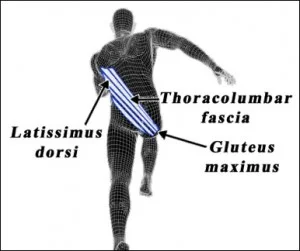
The Posterior Oblique Sling (POS) comprises of your opposite Latissimus Dorsi to Glute Max as well as the Biceps Femoris hamstring to the same side Glute (not seen in this pic).
This is a functional fascial line utilised in any movement requiring rotation or rotational stability. If you imagine yourself walking or running and take note of what your arms and legs are doing you will find: as your left leg steps through and is behind you, your right arm will be swung back and visa versa as you continue in a forward motion. This is where your POS comes into play on a regular basis. Helping to stabilise your Lumbopelvic region against rotational forces when needed. If you are someone who walks with a "woddle" (over-rotating their pelvis) then you may have dysfunction in this area. As always, better to get assessed as an individual as there are no blanket rules.
If you play a sport that demands a lot of running or rotational movements (particularly golf; lacrosse; water polo; cricket & any sport that requires you to run) then it is even more imperative that you have a functional POS.
In order for something as simple as walking to be a functional movement, one of the things you need is a functional connection between your opposite lat to glut. If there is a break in the chain somewhere you will quite often find that your Sacroiliac Joint (SIJ) will try and compensate by compressing itself to create stability in the system, or your Thoracolumbar Fascia (TLF) will create tension. This is often why you might find the area where your lower back meets your pelvis constantly tightens up, no matter how much you try and release it.
If you are someone who repeatedly gets a locked up SIJ and gets it regularly manipulated or released, you might want to try and find out why it is happening. There will be dysfunction somewhere that is causing the joint to compress itself.
Your body will always find stability when it needs it and joints are no exception. If you don't feed your system with stability after creating more range of movement (stretching/foam rolling/massage/manipulation) then you are feeding a viscious cycle. Your joints/muscles/fascia/ligaments can compress in a desperate call for stability. You need to feed the motor control system the information necessary to correct dysfunction after releasing a dysfunctional pattern or it won't know what to do with the extra range of movement & extensibility.
If it is left open, nothing will change.
Sweet Little Things - Healthy Treat Recipes
This great little information packed ebook not only contains a wide variety of 12 different recipes, but also has a stack of information on the truth behind fats; how we need to form good food habits for our kids and the 10 essential ingredients you need to keep in your cupboard to always have a healthy treat option available to you.
GET YOUR DOWNLOADABLE 6 WEEK LIFESTYLE GUIDE EBOOK. ALL YOU NEED TO GET YOU BACK ON TRACK!
ABOUT MARY
Mary is a qualified Physiotherapist & Personal Trainer who loves movement and helping others get stronger & find confidence in their bodies.
She hit Menopause at the age of 41 and struggled through the fight of Perimenopause, coming out the other side with a wealth of knowledge and a strategy for strength training that works and keeps her & her clients consistent.
She has many qualifications under her belt and focuses on helping others improve their strength; fitness and core function in a safe, guided & supported way.
Don't miss out on free, useful information available on our social networks below. I'd love to see you there!
Check out our Instagram Feed…
RECENT BLOGS
BLOG CATEGORIES
