BLOG

Educational, How To Avoid Injury Mary Whaling Educational, How To Avoid Injury Mary Whaling

DO YOU STRUGGLE WITH PULLUPS?

Do you struggle with pullups? Maybe your Lats are failing?...
lats vs pecs pull up personal trainer Gold Coast.jpg

Did you know in order to do a full functional pullup you most definitely need your lats to be kicking in?!

Did you also know that if you are trying to execute a pullup that involves rolling your shoulders forward even slightly that you are making it increasingly difficult for your lats to engage?

Try this little exercise now:
- Place your hand under your armpit
- Making sure your shoulder is NOT rolled forward (chest open)
- Draw your shoulder blade down and squeeze your arm into your armpit
- You should feel your lat pop out into your hand
- Now roll that shoulder forward and try squeezing again

Much harder isn't it? You probably won't feel the lat pop out half as much and will struggle to connect with it in the same way you did previously.

This is what happens when you try and execute a pullup without utilising your large, powerful lats which should be doing the majority of the work. If you are over using your pecs and upper traps (which is often the case) you will only land up with neck and shoulder problems and a weak pullup.

This was the case for one of my clients. His brain was unable to locate his lats when tested using Neurokinetic Therapy and he was using his pecs and upper traps to try and gain the movement required. Much to his surprise, his pullups were a lot different after changing his motor control within the session.

Your shoulder blades should be drawn down during the pullup movement. You should start from a full hang and then draw your shoulder blades down to engage the lats and lower traps and from there comes the pull up towards the bar.

Always worth remembering: Just because you have well developed musculature doesn't always mean they will be functional.

Read More
Back Pain, Educational Mary Whaling Back Pain, Educational Mary Whaling

THE POSTERIOR OBLIQUE SLING...CONTROLLING ROTATIONAL FORCES

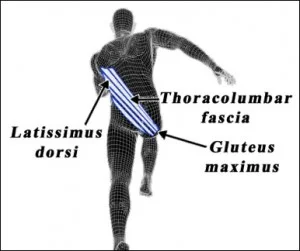
The Posterior Oblique Sling...why it is a vital functional fascial line for daily life, not to mention most sports.

The Posterior Oblique Sling (POS) comprises of your opposite Latissimus Dorsi to Glute Max as well as the Biceps Femoris hamstring to the same side Glute (not seen in this pic).

The Posterior Oblique Sling (POS) comprises of your opposite Latissimus Dorsi to Glute Max as well as the Biceps Femoris hamstring to the same side Glute (not seen in this pic).

This is a functional fascial line utilised in any movement requiring rotation or rotational stability.  If you imagine yourself walking or running and take note of what your arms and legs are doing you will find:  as your left leg steps through and is behind you, your right arm will be swung back and visa versa as you continue in a forward motion.  This is where your POS comes into play on a regular basis.  Helping to stabilise your Lumbopelvic region against rotational forces when needed.  If you are someone who walks with a "woddle" (over-rotating their pelvis) then you may have dysfunction in this area.  As always, better to get assessed as an individual as there are no blanket rules. 

If you play a sport that demands a lot of running or rotational movements (particularly golf; lacrosse; water polo; cricket & any sport that requires you to run) then it is even more imperative that you have a functional POS.

In order for something as simple as walking to be a functional movement, one of the things you need is a functional connection between your opposite lat to glut.  If there is a break in the chain somewhere you will quite often find that your Sacroiliac Joint (SIJ) will try and compensate by compressing itself to create stability in the system, or your Thoracolumbar Fascia (TLF) will create tension.  This is often why you might find the area where your lower back meets your pelvis constantly tightens up, no matter how much you try and release it.  

If you are someone who repeatedly gets a locked up SIJ and gets it regularly manipulated or released, you might want to try and find out why it is happening.  There will be dysfunction somewhere that is causing the joint to compress itself.  

Your body will always find stability when it needs it and joints are no exception.  If you don't feed your system with stability after creating more range of movement (stretching/foam rolling/massage/manipulation) then you are feeding a viscious cycle.  Your joints/muscles/fascia/ligaments can compress in a desperate call for stability.  You need to feed the motor control system the information necessary to correct dysfunction after releasing a dysfunctional pattern or it won't know what to do with the extra range of movement & extensibility.  

If it is left open, nothing will change.

Read More

GET YOUR FREE DOWNLOADABLE HEALTHY TREATS RECIPE EBOOK HERE!

Sweet Little Things - Healthy Treat Recipes

This great little information packed ebook not only contains a wide variety of 12 different recipes, but also has a stack of information on the truth behind fats; how we need to form good food habits for our kids and the 10 essential ingredients you need to keep in your cupboard to always have a healthy treat option available to you. 


GET YOUR DOWNLOADABLE 6 WEEK LIFESTYLE GUIDE EBOOK. ALL YOU NEED TO GET YOU BACK ON TRACK!


ABOUT MARY

Mary is a qualified Physiotherapist & Personal Trainer who loves movement and helping others get stronger & find confidence in their bodies.

She hit Menopause at the age of 41 and struggled through the fight of Perimenopause, coming out the other side with a wealth of knowledge and a strategy for strength training that works and keeps her & her clients consistent.

She has many qualifications under her belt and focuses on helping others improve their strength; fitness and core function in a safe, guided & supported way.


Don't miss out on free, useful information available on our social networks below. I'd love to see you there!


Check out our Instagram Feed…


RECENT BLOGS


BLOG CATEGORIES